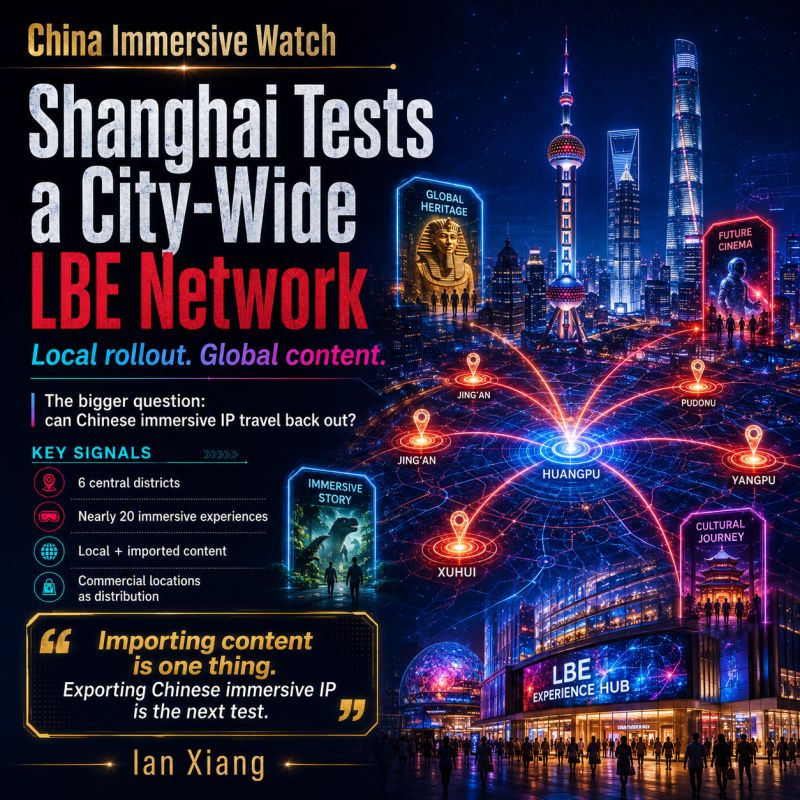
Shanghai is testing something important for the future of LBE large-space.
Not one flagship VR project.
A city-wide immersive experience network.
From 17 May to 17 June, the 2026 Shanghai Information Consumption Festival is running one of its key metaverse sections across six central districts: Huangpu, Jing’an, Hongkou, Yangpu, Xuhui and Pudong.
That is the first signal.
Nearly 20 immersive experiences are being placed across commercial locations, covering red culture, Shanghai city memory, national defence technology, science exploration, global civilisation, historical themes and family entertainment.
But there is a second signal that may be even more important.
Shanghai is not only showcasing local content.
It is also importing global immersive content.
The article mentions international or global-facing titles such as The Horizon of Khufu / 消失的法老, Fortress 1304 / 要塞1304, Space Odyssey, Journey to the Centre of the Earth and other large-space VR formats.
That tells us something important.
China’s immersive market is not closed.
It has appetite for strong foreign content, especially when the experience is story-led, visually powerful, culturally legible and operationally proven.
My view:
This is where the next question becomes interesting.
If China is willing to import global immersive content, can Chinese immersive content travel the other way?
China has the ingredients.
Large audiences.
Fast testing cycles.
Strong local operators.
Cultural IP.
Museum and heritage resources.
Government support.
Growing XR production capability.
But international export is a different test.
A Chinese LBE experience that works in Shanghai may not automatically work in London, Manchester, Paris, Dubai or New York.
The operator questions change:
Is the story understandable outside China?
Does the cultural context translate?
Can the experience sell without prior IP awareness?
Can the format fit Western venues and staffing models?
Can ticket pricing cover rent, marketing, insurance, labour and localisation?
Can it compete with Egyptian, space, fantasy, gaming and Hollywood-linked immersive content?
That is the real opportunity.
Not “China exports VR.”
But China learns how to turn cultural content into internationally marketable visitor products.
This is also why foreign content doing well in China matters.
It gives Chinese creators a mirror.
It shows what travels: clear world-building, universal curiosity, strong visual identity, simple visitor promise and reliable operations.
The next stage of China’s immersive industry may not only be about building more LBE venues inside China.
It may be about discovering which Chinese stories can become global immersive experiences.
Can Chinese immersive content travel internationally, or does it still need a stronger productisation layer before global audiences can buy into it?
Dafydd Sills-Jones and 10 others
Originally published on LinkedIn as part of China Immersive Watch.