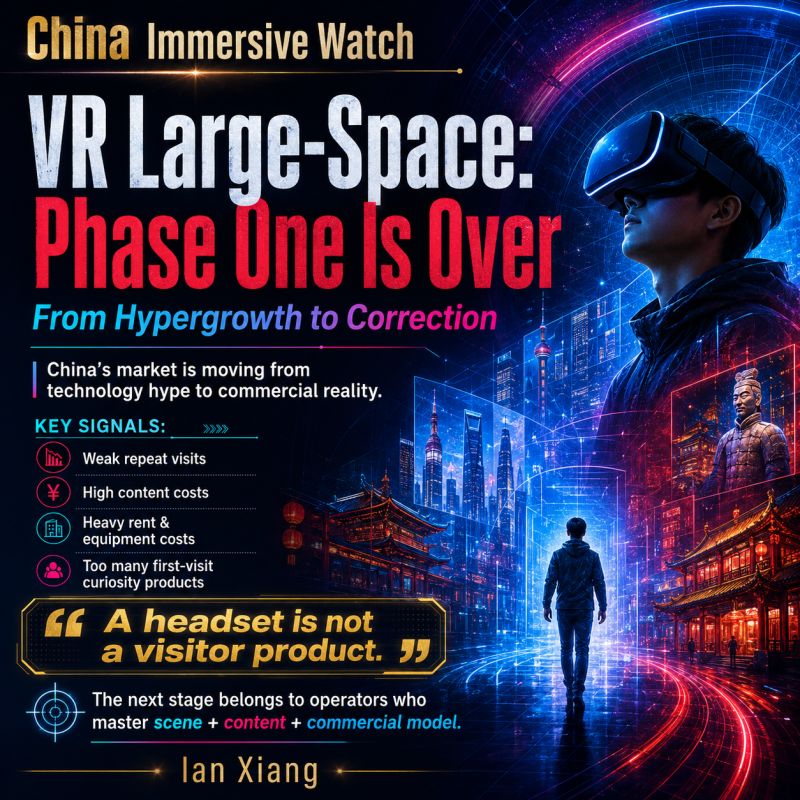
China’s VR large-space market may be entering its first real correction.
And that is a good thing.
From 2023 to 2025, China’s VR large-space market moved fast.
New projects appeared across malls, scenic areas, museums and cultural tourism sites. Investors, content studios, hardware companies and local governments all moved into the category.
But 2026 is starting to show a different signal.
The first stage of VR large-space was driven by excitement, technology and expansion.
The next stage will be driven by survival.
According to recent Chinese industry commentary, many VR cultural tourism projects are now facing the same problems:
Reportedly low repeat visits.
High content development costs.
Weak daily footfall.
Heavy rent and equipment costs.
Too many similar experiences.
Too many projects built around first-time curiosity, not long-term demand.
This is the real signal.
The market is not saying VR large-space has no future.
It is saying the first model was too weak.
My view:
A VR large-space project cannot survive on technology novelty.
A headset is not a visitor product.
A beautiful CG scene is not a business model.
A large space is not automatically an attraction.
The operator question is much more basic:
Who is the visitor?
Why are they coming?
What occasion does this serve?
Will they pay the price?
Will they come as a group?
Will they share it?
Will the venue convert passing footfall into ticket sales?
Can the project cover rent, staffing, marketing, content updates and equipment maintenance?
This is where many projects failed.
They treated VR large-space as an independent entertainment category.
But in many cases, it works better as an experience layer inside an existing traffic system: a museum, scenic site, theme park, school-trip destination, cultural venue, cinema, tourism district or family entertainment hub.
That is the difference between installing VR and operating a visitor product.
The winners in the next stage will probably not be the teams with the biggest screens, longest stories or most expensive visuals.
They will be the teams that understand the triangle:
Scene.
Content.
Commercial model.
The article makes one point I strongly agree with:
The second stage belongs to players who can create high experience value at controlled cost.
That means shorter development cycles, lighter hardware, modular content, stronger group use cases, clearer pricing, better venue fit and more repeatable operations.
For China, this correction matters.
Because China is not only testing what works.
It is also testing what fails at speed.
That may be the most useful lesson for the global immersive industry.
The future of VR large-space will not be decided by whether the technology is impressive.
It will be decided by whether the experience can become a sustainable visitor business.
Is VR large-space becoming a serious cultural tourism format, or are too many operators still treating it as a technology showcase?
Originally published on LinkedIn as part of China Immersive Watch.