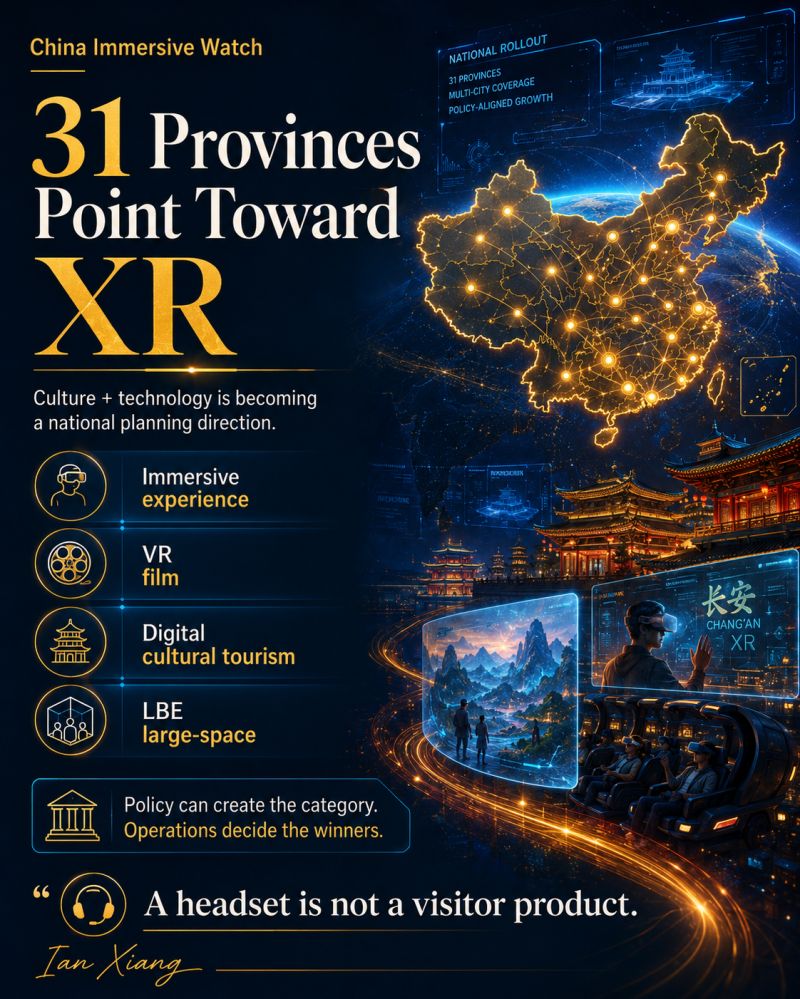
31 Chinese provinces are now talking about XR, VR and AR in a very similar way.
That is the signal I am watching.
According to recent analysis of China’s provincial 15th Five-Year Plan directions, many provinces are using the same core language: culture + technology, immersive experience, virtual reality film, digital cultural tourism and new productive forces.
For people outside China, this may sound like policy language.
But in China, repeated policy language often matters.
It tells local governments, cultural tourism operators, venues, studios, investors and technology companies where resources may flow next.
The important point is not that one province wants to build an XR project.
The important point is that many provinces are now treating immersive experience as part of cultural tourism infrastructure.
Some regions are discussing international digital culture expos, cross-border immersive entertainment centres and LBE large-space formats as part of future cultural tourism planning.
That matters because China is moving immersive entertainment from “interesting project” to “planned category.”
My view:
This is how a market starts to industrialise.
First, projects appear.
Then successful formats are copied.
Then local governments begin to recognise the category.
Then standards, subsidies, infrastructure, talent, content pipelines and venue networks start to form around it.
But here is the warning.
Policy alignment does not automatically create good visitor experiences.
A province can write XR into a plan.
A venue can buy headsets.
A scenic site can install a VR theatre.
A shopping centre can add an LBE large-space unit.
None of that guarantees demand.
The commercial test is still the same:
Will people buy a ticket?
Will they understand the story?
Will they bring friends or family?
Will the venue manage throughput, pricing, staffing, safety and marketing?
Will the content still feel fresh after the first wave of visitors?
China’s value is not that every immersive project will succeed.
Many will not.
The value is the scale and speed of testing.
When 31 provinces begin pointing in a similar direction, the industry can test formats faster than almost anywhere else.
This is why I keep watching China.
Not because the policy language is exciting.
But because policy can create the conditions for large-scale experimentation.
The real winners will not be the provinces that mention XR most often.
The winners will be the operators who turn culture, story, space, technology and operations into visitor products people actually want to experience.
Is immersive entertainment becoming cultural tourism infrastructure, or are we still treating it as a temporary attraction?
Yiannis Cabolis and 12 others
1 repost
Originally published on LinkedIn as part of China Immersive Watch.