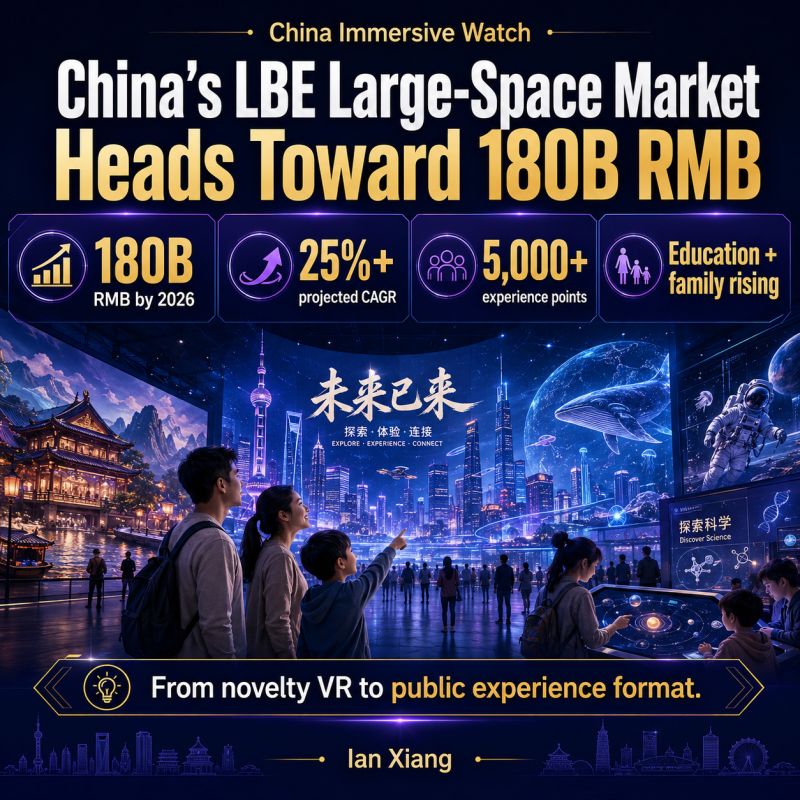
China’s LBE large-space immersive market is projected to pass 180 billion RMB in 2026.
That is the latest signal I am watching from China.
According to recent industry reports, China’s location-based entertainment large-space immersive market could maintain more than 25% annual growth between 2025 and 2030.
By Q3 2025, China reportedly had more than 5,000 VR large-space experience points across major cities and lower-tier markets.
But the most interesting part is not only the market size.
It is where the growth is coming from.
The market is no longer only about gaming or novelty VR.
Education, science communication and Family experiences are becoming one of the fastest-growing application areas.
That matters.
Because family and education use cases change the business logic.
A VR game may be a one-time entertainment purchase.
But a parent-child science experience, museum experience or cultural learning product can connect with schools, families, libraries, museums, tourism destinations and public cultural venues.
Examples mentioned in the report include Life Journey, an immersive science exhibition turning the evolution of life into an interactive experience, and Jinling Forty-Eight Views, an XR project that lets visitors interact with local history through digital storytelling.
My view:
China is testing whether large-space VR can move from “entertainment attraction” into a wider public experience format.
Not just for gamers.
For families.
For schools.
For museums.
For libraries.
For cultural tourism.
For city-level public engagement.
That is important for the global market.
If LBE VR becomes family-friendly, educational and culturally useful, it has a much bigger route to scale than pure entertainment.
My prediction:
The next phase of immersive entertainment will not be won by technology alone.
It will be won by formats that solve real venue and audience problems.
Shopping centres need reasons for people to visit.
Museums need younger audiences to engage.
Cities need new cultural tourism products.
Parents need meaningful activities for children.
Schools need learning experiences that students remember.
LBE large-space immersive formats can sit across all of these.
But here is the warning.
Scale does not guarantee quality.
More venues do not automatically mean better experiences.
The industry still needs stronger storytelling, better operations, clearer pricing, safer visitor flow, more repeatable content models and less reliance on novelty.
China is not only expanding VR large-space entertainment.
It is testing where this format can live in everyday society.
That could matter far beyond China.
Is the future of LBE VR entertainment, education, cultural tourism, or all three?
Guttmann Vincent and 15 others
1 repost
Originally published on LinkedIn as part of China Immersive Watch.