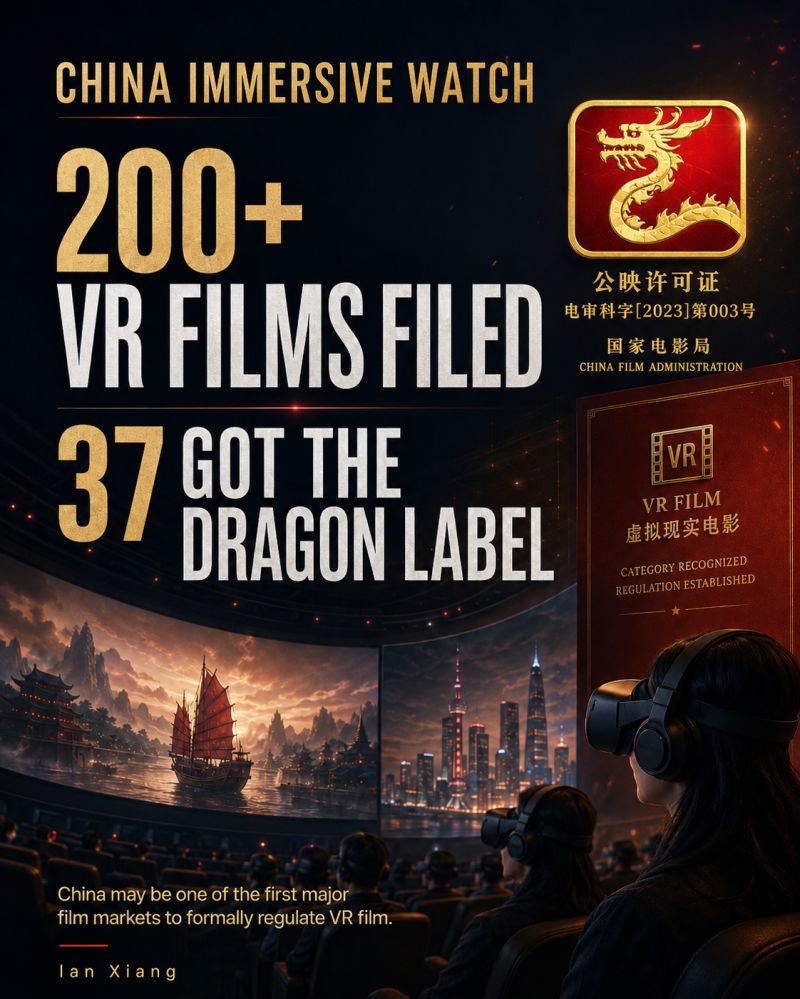
China may be one of the first major film markets to formally regulate VR film as a film category.
That is a big signal.
By the end of March 2026, more than 200 VR film projects had reportedly been submitted for official filing in China.
Around 140 had received filing receipts.
37 had received the official “Dragon Label.”
For non-Chinese audiences, the “Dragon Label” is the approval required for films to be publicly released in China.
So why does this matter?
Because VR film is no longer being treated only as a tech demo, arcade attraction or one-off experiment.
It is starting to enter the formal film system.
In March 2025, China’s film authority issued guidance to bring VR films into the film management framework. These are films made with VR, AR or MR technology, viewed through headsets, and publicly screened in fixed cinema-style venues.
More importantly, VR films are being included in China’s national box office statistics system.
That changes the conversation.
Once a format can be filed, approved, screened, measured and monetised through a formal system, it starts moving from novelty into category.
My view:
China is testing whether VR film can become a structured entertainment format, not just an immersive attraction.
This new category sits between cinema, theatre, gaming, cultural tourism and location-based entertainment.
Some formats are walking large-space experiences.
Some are seated VR cinema halls.
Some are mobile cinema formats for smaller cities and towns.
My prediction:
VR film will not replace cinema.
But part of the film industry will move into immersive, location-based formats.
Major IPs will not only live as films, games and merchandise.
Many will become visitor experiences.
A film world can become a place.
A character can become an encounter.
A story can become a ticketed group experience.
But here is the warning.
A VR film cannot simply be a normal film placed inside a headset.
A linear story does not automatically become immersive.
To work, it needs presence, pacing, comfort, interaction, space, audience flow and venue operation.
Policy can create the category.
Technology can enable the format.
But audience experience decides whether people come back.
That is why this matters.
China is not only producing VR films.
It is testing whether immersive cinema can become organised, regulated and commercially scalable.
If that works, even partially, Hollywood, Bollywood and other major film industries will have to pay attention.
Is VR film the future of cinema, tourism, or a new category of its own?
Julian Reyes and 35 others
2 reposts
Originally published on LinkedIn as part of China Immersive Watch.