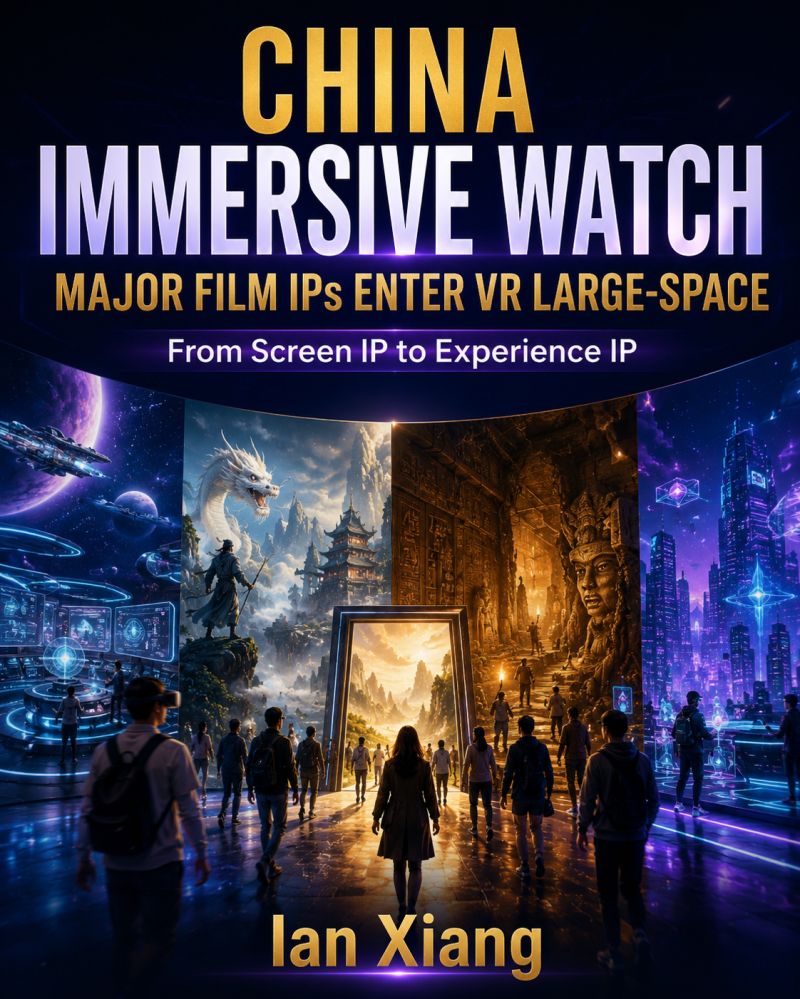
Major film IPs are entering VR large-space entertainment.
This is one of the biggest signals I am watching in China’s immersive market.
China is testing whether major entertainment IPs can move from screen-based storytelling into VR large-space and VR cinema experiences.
Projects are now linked to The Monkey King, The Three-Body Problem, Ghost Blows Out the Light and Honor of Kings.
These are not small experiments. They are major IPs with public recognition and strong fan communities.
That matters because VR large-space still has one major barrier: most mainstream audiences do not fully understand what it is yet.
For many people, VR still means an old shopping mall simulator, a headset that makes you dizzy, or a short novelty game.
Before the industry can scale, the public first needs to understand why this format matters.
This is where major IP changes the market.
A Three-Body Problem fan only needs to hear: “You can walk inside Red Coast Base.”
A Monkey King fan only needs to hear: “You can step into the world of Sun Wukong.”
That is the power of IP.
It reduces the cost of explanation and gives people a reason to try a format they may not otherwise understand.
My view:
China is becoming one of the fastest live testing grounds for turning major IP into VR and XR visitor experiences.
Will every project succeed? Probably not.
Some will rely too much on the IP name. Some will look beautiful but fail as real visitor products.
But even the testing itself is important.
Every major IP entering this space helps move VR and XR from niche technology into public awareness.
My prediction:
Many major film IPs, not all, but many of the biggest ones, will eventually be rebuilt as VR or XR large-space experiences.
Not because cinema will disappear.
Because the most valuable IPs are no longer only stories to watch. They are worlds to enter.
Hollywood, Bollywood and other major film industries may not move exactly like China.
But I believe they will move in the same direction.
The future of major IP may look like this:
Watch the film.
Play the game.
Buy merchandise.
Visit the world.
Step inside the story.
But a film cannot simply be copied into VR.
A two-hour linear story does not automatically become a good immersive experience.
To work, the IP has to be redesigned around movement, presence, pacing, interaction, comfort, venue operation and repeat visits.
IP brings people through the door.
Experience quality decides whether they care.
Operation decides whether the business survives.
That is why China’s current testing matters.
China is testing whether major IP can become physical, social, immersive visitor products.
If that works, even partially, the global entertainment industry will have to pay attention.
The future is not only film IP as content.
It is film IP as experience, as place and as presence.
What major film or story world would you most want to physically step inside, and what would make it worth paying for?
1 repost
Originally published on LinkedIn as part of China Immersive Watch.