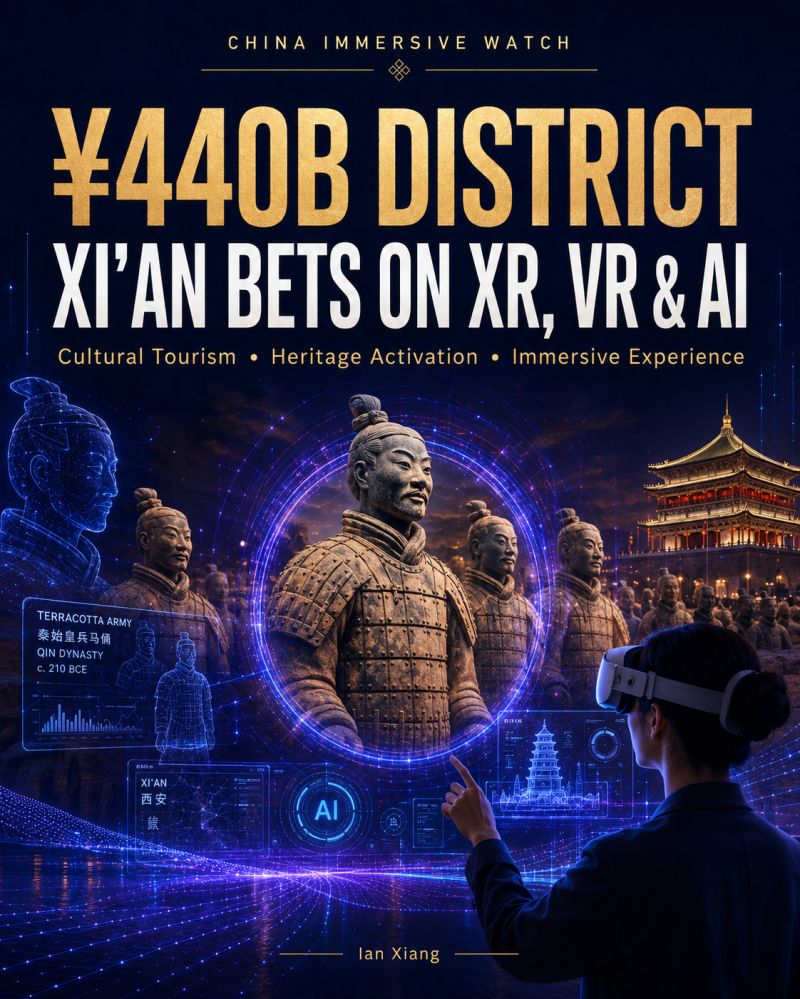
A 440 billion RMB district is putting XR, VR and AI at the centre of cultural tourism.
This signal I am watching from Xi’an.
For non-Chinese audiences, Xi’an is one of China’s most important historical cities, known for the Terracotta Warriors, ancient city wall, Big Wild Goose Pagoda, Tang culture and the Silk Road.
Now Xi’an’s Yanta District has set out a new direction around “technology + culture.”
The headline number is serious.
The district aims to reach over 440 billion RMB in GDP, attract more than 40 major industrial projects, grow to over 1,200 technology SMEs and 900 high-tech enterprises, and receive more than 50 million visitors a year.
This is not only a tourism story.
It is an industrial strategy.
The district is looking at VR museum experiences, AI tourism services, heritage scanning, 3D modelling, virtual scenic spot reconstruction, cultural storytelling, historical character interaction and intangible heritage digitisation.
That matters because China is testing a new model for cultural tourism.
Heritage is no longer only something to preserve.
It is becoming content infrastructure.
Once heritage becomes content infrastructure, XR and VR can turn it into visitor products.
My view:
Xi’an is testing whether a historic city can use immersive technology to make culture more accessible, emotional and active.
The challenge is not whether Xi’an has enough stories.
It has more than enough.
The real challenge is whether those stories can become experiences people want to visit, share, pay for and remember.
My prediction:
Many historic cities will use XR and VR to rebuild parts of their past as immersive visitor experiences.
Not to replace real heritage sites.
But to help people understand them, feel them and connect with them.
Imagine walking through ancient Chang’an.
Standing inside a Tang dynasty market.
Seeing a lost building reconstructed around you.
Meeting a historical figure through an interactive story. ( Tang Dynasty is already in Immersia XR
That is where cultural tourism could go.
But here is the warning.
Digitising heritage is not the same as productising heritage.
A 3D scan is not automatically an experience.
A virtual reconstruction is not automatically a visitor product.
A famous cultural site is not automatically commercially viable.
To work, it still needs story structure, visitor flow, emotional design, operations, pricing, marketing and a reason for people to come.
This is why Xi’an matters.
China is not only testing XR as technology.
It is testing whether cultural heritage can become physical, social, immersive visitor products.
Some projects will become shallow spectacle.
Some will be too technical.
Some will forget the emotional power of the culture.
But the direction matters.
The future of heritage tourism may not only be about showing culture.
It will letting people step inside it.
Can immersive technology help younger audiences connect with heritage, or are we at risk of turning culture into spectacle?
Wim Stocks and 28 others
3 reposts
Originally published on LinkedIn as part of China Immersive Watch.