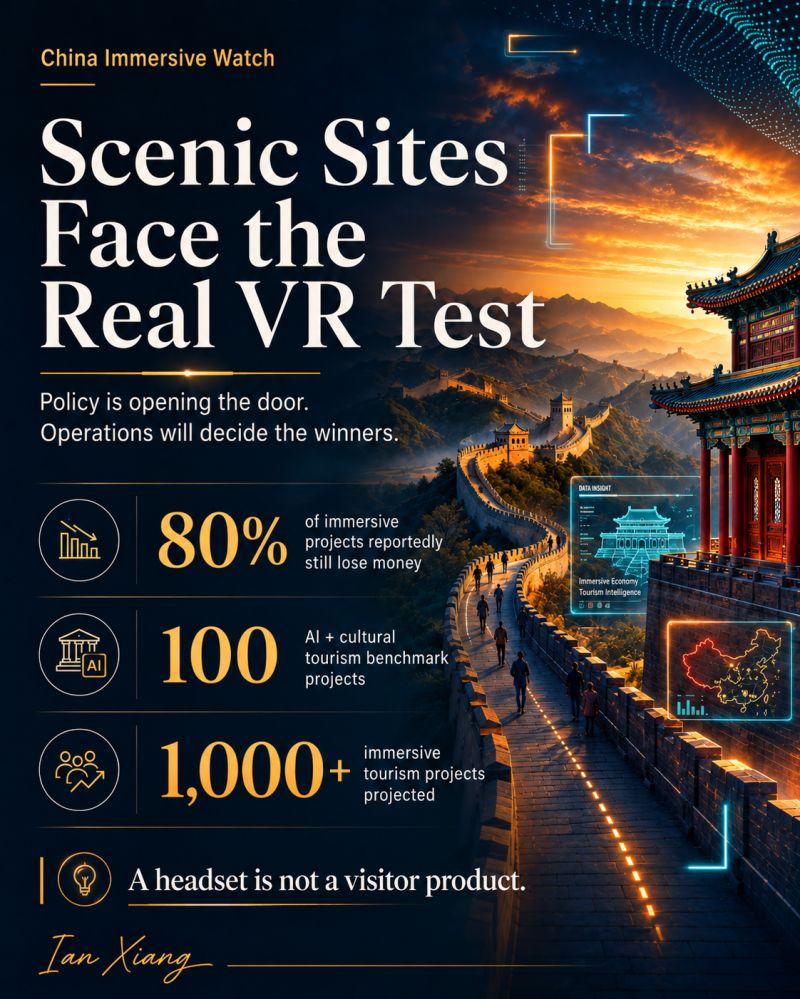
China’s scenic sites are being pushed into the VR era.
But the real question is not whether they can get funding.
It is whether they can build experiences people actually want to pay for.
A recent Chinese industry article argues that cultural tourism VR is entering a new policy window under China’s 15th Five-Year Plan.
The direction is clear: culture and technology are being pulled closer together. AI, VR, XR, digital heritage, immersive storytelling and smart tourism are becoming part of the next phase of cultural tourism.
That matters because many scenic sites in China are facing the same problem.
They have history.
They have footfall.
They have cultural resources.
But many still depend on passive sightseeing, ticket sales and photo-taking.
VR and XR offer a possible new layer: helping visitors step into a story, understand a place, and feel the history rather than only look at it.
My view:
This is where many projects will get it wrong.
A VR project is not an upgrade just because a scenic site buys headsets.
A screen is not a product.
A headset is not an experience.
A 3D reconstruction is not automatically emotional.
A subsidy is not a business model.
The real shift is from hardware procurement to experience operation.
For a scenic site, the key question should be:
What memory does the visitor take away after the experience?
If the answer is unclear, the technology will not save the project.
The article uses The Great Wall full-sensory theatre as one example. The format reportedly combines XR, AI digital humans, game-engine visuals, spatial audio and motion platforms, turning visitors from spectators into participants in a Great Wall story.
That direction is important.
Not because every scenic site should copy this format.
But because it shows what cultural tourism VR needs to become: story-led, site-relevant, operationally manageable and commercially measurable.
My prediction:
The next wave of cultural tourism VR in China will not be judged by how advanced the technology looks.
It will be judged by visitor flow, conversion rate, dwell time, secondary spend, repeatability and whether the experience makes the cultural site easier to understand and remember.
But here is the warning.
Policy support can accelerate adoption, but it can also create lazy projects.
When subsidies arrive, many operators rush to install equipment before they understand the visitor journey.
That is how immersive projects become expensive decoration.
The winners will not be the scenic sites that “add VR.”
The winners will be the ones that turn culture, story, space, technology and operation into a real visitor product.
Can VR help heritage sites create deeper visitor memories, or will many projects become another layer of digital decoration?
What are you seeing in your market?
Kurt Jackson and 10 others
Originally published on LinkedIn as part of China Immersive Watch.