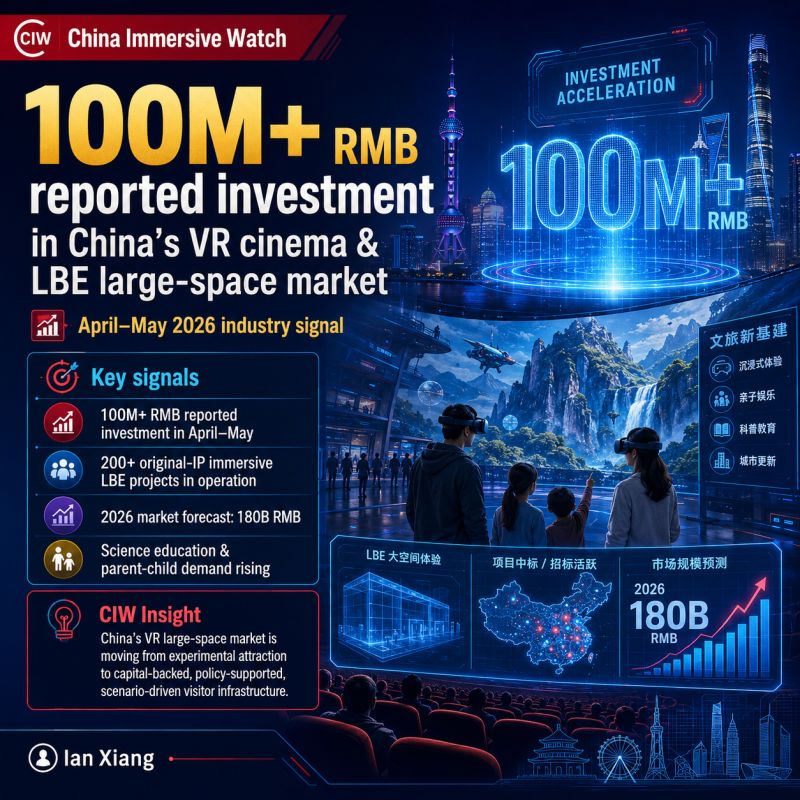
China’s VR cinema and LBE large-space market saw over 100 million RMB in reported investment activity across April and May.
According to a news “VR Film / Large-Space Intelligence Station” summary, China’s LBE large-space and VR film sector recorded more than 100 million RMB in investment activity during the two months.
The activity covered new projects, VR film development, rollout of China’s virtual reality film “Dragon Label” system, government and enterprise tenders, exhibitions and venue deployment.
The wider industry signal also matters.
The report says China already has more than 200 original-IP-based large-space immersive LBE projects in operation, and that the market could exceed 180 billion RMB in 2026, with a compound annual growth rate above 25%.
Important distinction: the 100 million RMB figure refers to reported April–May investment activity. The 180 billion RMB figure is a market forecast.
This is the China signal I am watching.
VR cinema and large-space LBE are no longer advancing only through isolated experiments.
They are being driven by capital, policy, tenders, content production, venue deployment and film regulation at the same time.
That combination matters.
In many markets, immersive entertainment still grows project by project. One venue opens, one production tours, one museum tests VR, one shopping centre tries a pop-up.
China is starting to look more like an industrial pipeline.
Projects, content, hardware, procurement, cinema certification, tourism scenarios and education experiences are moving together.
My view:
The most interesting shift is not only the investment number.
It is the change in application scenarios.
Science education and parent-child experiences are reportedly growing fast, becoming one of the strongest areas after culture-tourism integration.
That matters because family and education use cases may provide a stronger commercial base than novelty entertainment.
Families need activities. Schools need educational formats. Museums and science centres need engagement tools. Shopping centres need reasons for people to visit.
But the same question remains: can these projects become repeatable visitor products rather than impressive installations?
A large-space VR project still has to solve basic operator problems: content quality, audience fit, footfall, pricing, staff training, safety, repeat visits and venue economics.
China is testing all of this at speed.
Some projects will become serious entertainment and education anchors. Others will disappear once the novelty fades.
But the direction is clear: VR large-space is moving from experimental attraction to capital-backed, policy-supported and scenario-driven visitor infrastructure.
The real question is:
Can VR cinema and large-space LBE become a sustainable venue format, or will the market split between strong operator-led products and short-lived technology showcases?
Jacob Beckett 💊 and 5 others
Originally published on LinkedIn as part of China Immersive Watch.