Why Story-Led XR Feels Fundamentally Different?
The moment that changed my thinking was not during a launch or a pitch.
It was at the exit.
A woman had just taken off her headset. She didn’t say anything for a few seconds. Then she smiled, wiped her eyes, and said quietly, “I didn’t expect that.”
She had tears on her face.
That moment stayed with me.
Over the following weeks, after thousands of visitors and hundreds of small conversations like this, I realised something important about immersive experiences.
A lot of our visitors told me they had already done many VR or XR experiences. Famous places. Ancient sites. Big digital worlds.
They enjoyed them.
So this isn’t about saying those experiences are not good. They are doing exactly what they are designed to do.
But Immersia XR is doing something different.
And the difference is simple.
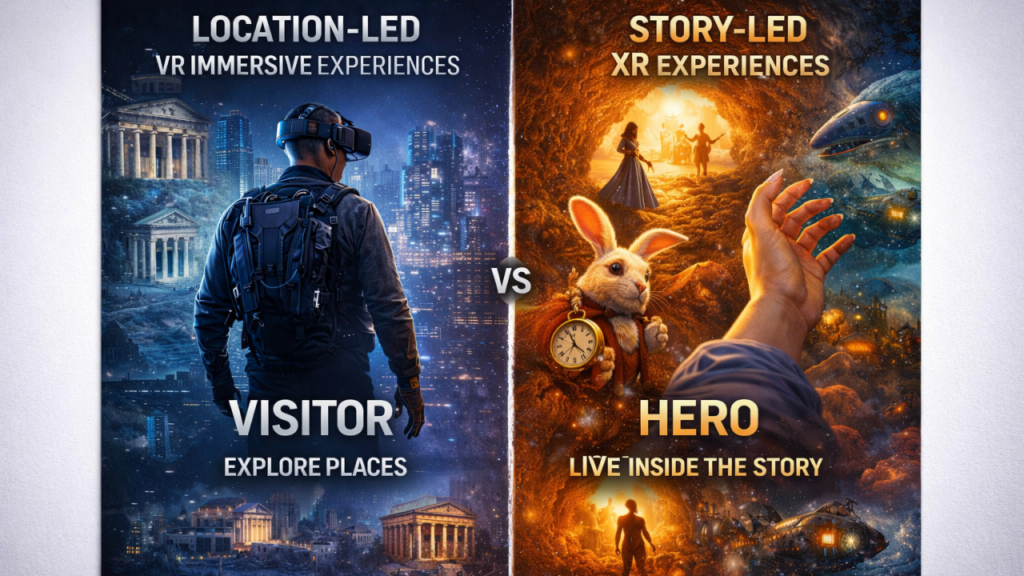
Location-led immersive experiences are a new way to explore a place. Story-led XR immersive experiences are a new way to tell a story.
Most immersive experiences today are location led. You are placed inside a world and invited to explore it. You observe. You move. You discover.
You are a visitor.
At Immersia XR, everything starts from story.
Not the environment. Not the technology. The story.
And more importantly, the point of view.
When someone steps into Alice in Wonderland, they already know the story. That familiarity is intentional. But instead of watching Alice, you become Alice.
You experience Wonderland from a first-person view. What Alice sees, you see. What she experiences, you experience. The story unfolds through you.
You are not following the narrative. You are inside it.
The same thinking applies across all our stories.
In Tales of Aladdin, you don’t explore a world. You live the adventure. The story moves you forward, scene by scene, from your own perspective.
In Journey to the Centre of the Earth, you don’t stand back and admire scale. You feel the descent. Each step takes you deeper, building tension because you are the one moving forward.
In 20,000 Leagues Under the Sea, the pace changes. You slow down naturally. You experience the underwater world from within it. Some people come out calmer. Some come out emotional. I’ve seen tears more than once. Not from drama, but from connection.
That’s when it became clear to me.
Location-led experiences show you where you are. Story-led experiences focus on how you feel.
Technology still matters. Visual clarity matters. Resolution matters. But not to impress. It matters because emotion lives in small details. A look. A pause. A shift in atmosphere.
This also explains something else I kept seeing.
Children step in without hesitation. Parents stay emotionally engaged. Grandparents connect because they already know the stories.
I’ve watched three generations come out talking about the same moment. Not the tech. Not the space. The story.
Running Immersia XR changed how I think about immersive experiences.
Location-led experiences give us a new way to explore the world. Story-led XR gives us a new way to experience stories we already know.
They are not competing ideas. They are different approaches.
Immersia XR simply chooses to tell stories, and to let people experience them from the inside.
I’m curious what you think.
When you think about immersive experiences, do you want to explore a place, or do you want to step into a story and live it for a while?
I’d love to hear your thoughts.
Originally published on LinkedIn on December 19, 2025.