What I’ve learned running Immersia XR is that the next shift in storytelling isn’t about technology, but about bringing the body back in.
Running Immersia XR has made me rethink storytelling in a very practical way.
Not as theory. As something I see every day.
For most of human history, storytelling has moved in one clear direction.
Closer. More immersive. More embodied.
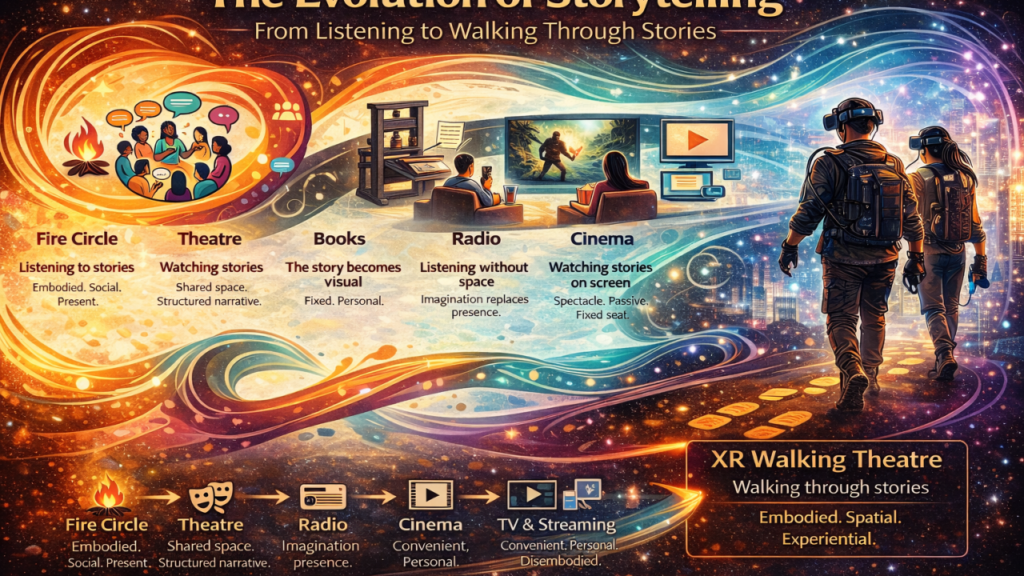
We didn’t start with screens. We started beside a fire.
People gathered in a circle. Someone told a story. Others listened. You could feel the heat. You could sense the people around you. Storytelling was physical and social.
Then came theatre. Stories moved onto a stage. Structured. Shared. Still live.
Then books and the printing press. Stories became fixed. Scalable. World changing. But also silent and solitary. The story moved into the private space between a reader and a page.
Then radio. Stories travelled through sound. Portable, but still disembodied.
Then cinema. Stories became visual, spectacular, repeatable. But the body disappeared. You sit. You watch. You leave.
Then television and streaming. Stories moved into private screens. On demand. Endless. Convenient.
And something else happened.
The audience stopped moving.
We watch more stories than ever, yet feel less present inside them.
Streaming solved distribution. It didn’t solve embodiment.
This is where XR Walking Theatre starts to make sense to me.
XR Walking Theatre isn’t a tech shift. It’s a storytelling shift.
At Immersia XR, people don’t just watch stories. They walk through them.
They move through space. Their pace matters. Their position matters. They’re aware of others, even while inside their own narrative.
Instead of listening, you move. Instead of watching, you walk through the story.
In many ways, it feels closer to the fire than to the screen.
That’s why I see XR Walking Theatre as the next natural step in storytelling.
From listening, to reading, to watching, to walking through stories.
Books trained us to imagine in silence. Cinema trained us to be passive. Streaming trained us to be comfortable.
XR Walking Theatre trains us to journey.
And I notice one simple thing every day.
People don’t say, “I watched something.” They say, “I was inside it.”
That shift matters.
XR Walking Theatre doesn’t replace books, cinema, or streaming. It sits alongside them.
Fire didn’t disappear when theatre arrived. Cinema didn’t disappear when streaming arrived.
Each form added a layer.
XR Walking Theatre adds back what storytelling has slowly lost.
The body. The space. The shared journey.
This is why I’m building Immersia XR.
Originally published on LinkedIn on January 13, 2026.