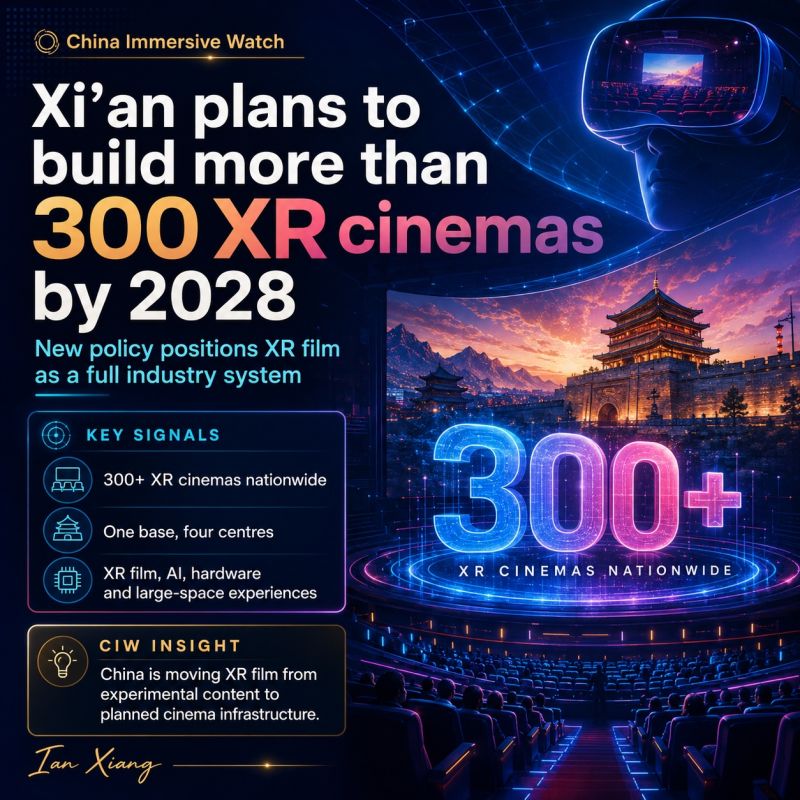
Xi’an plans to build more than 300 XR cinemas by 2028.
On 12 June, the Xi’an Municipal Government released policies to support the city’s XR film industry. The goal is to build a nationally important virtual reality film cluster by 2028, focusing on content, technology, industry organisation, market operations and branding.
The plan follows a “one base, four centres” model:
An XR film industry base, a VR film technology innovation centre, an XR industry innovation centre, a film AI model lab and an AI film production lab.
Xi’an also aims to develop two XR hardware companies with annual revenue above 100 million RMB and support the rollout of more than 300 standardised XR cinemas nationwide.
This is a major signal.
XR film is no longer viewed only as an experiment.
Xi’an is building a complete industry system covering content, standards, hardware, cinema design, ticketing, encryption, AI creation, virtual production, spatial audio, lightweight headsets, interactive seating and large-space XR experiences.
Culture is equally important.
The city plans immersive XR experiences based on Qin Shi Huang’s Mausoleum, Han Chang’an, Tang Daming Palace and other historical sites, alongside projects linked to Tang culture, the Silk Road and Qinqiang opera.
This raises a bigger question:
Can a historic city turn cultural memory into a new cinematic format?
My view:
This is one of the clearest examples of China moving XR from a technology showcase to planned cultural infrastructure.
The key is not just the 300 XR cinemas.
It is the full-chain strategy.
Xi’an is linking policy, AI, film production, hardware, standards, tourism, cinema operations and local heritage into one model.
Globally, XR cinema is still often treated as a niche attraction.
Xi’an is positioning it as a future cinema network.
Not every project will succeed.
But China is testing XR at a scale few markets are matching.
The question is no longer whether XR film can exist.
China has moved beyond that.
The next question is whether XR film can become a repeatable cinema format with enough content, audiences and commercial logic to support a national network.
If Xi’an succeeds, XR cinema could become a major bridge between film, cultural tourism and location-based entertainment.
Can XR film become the next cinema format, or will it remain a specialised immersive attraction?
Roy Hanney and 3 others
1 repost
Originally published on LinkedIn as part of China Immersive Watch.